

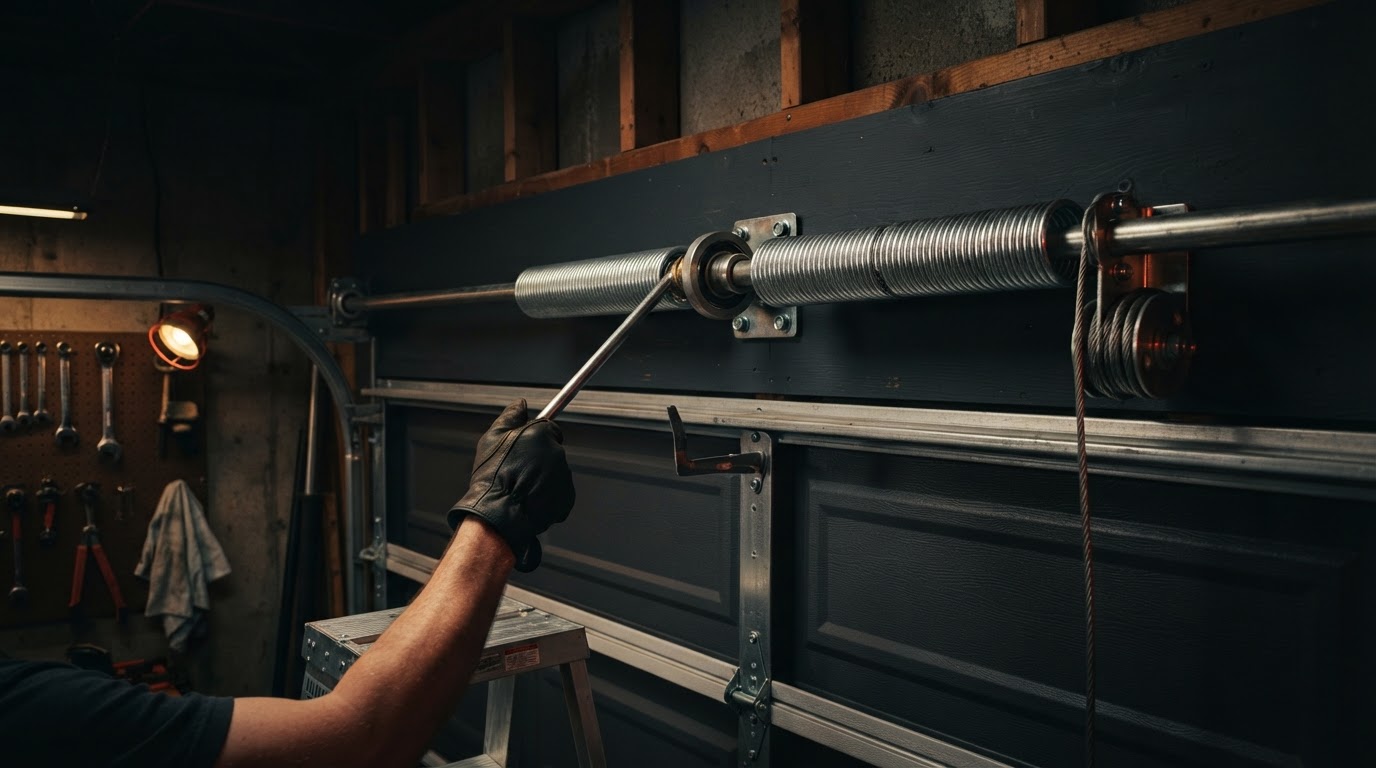
Spring Replacement vs. Repair: When to Fix vs. Replace Your Garage Door Springs
If you've ever heard a loud bang from your garage — like a firecracker went off inside — there's a good chance a garage door spring just snapped. Garage door springs are the single most-failed component on residential garage doors, responsible for roughly one in three service calls we get across San Jose, Santa Clara, and the Peninsula.
The good news: spring failure is almost always fixable. The tricky part: knowing whether you need a simple repair, a single spring replacement, or a full spring system upgrade — and knowing why you should never, ever try to fix a spring yourself.
Let's break it down.
Quick Navigation
- Torsion vs. Extension Springs — Know What You Have
- 7 Warning Signs Your Springs Need Attention
- When Repair Works vs. When Replacement Is Smarter
- Why DIY Spring Repair Is Genuinely Dangerous
- Real Bay Area Cost Guide
- What to Expect From a Professional Spring Service
- How Long Do Springs Actually Last?
- FAQ
1. Torsion vs. Extension Springs — Know What You Have
Before you can decide "repair or replace," you need to know which spring system your door uses. There are two main types, and Bay Area homes have both.
Torsion Springs
- Mounted horizontally above the door on a metal shaft
- Twist to store energy as the door closes; unwind to lift the door
- Standard on most doors installed after ~2000
- Lifespan: 10,000 cycles (about 7–10 years) for standard, up to 20,000+ for heavy-duty
- Safer, quieter, more durable — the modern default
Extension Springs
- Mounted along both horizontal tracks, running parallel to the ceiling
- Stretch to store energy; contract to lift the door
- Common in older Bay Area homes (Willow Glen ranches, older Palo Alto craftsman garages, mid-century Sunnyvale Eichlers)
- Lifespan: 10,000 cycles (about 6–8 years)
- Slightly noisier, more prone to failure, but still fine when properly installed with safety cables
Look up above your door. If you see one or two large springs on a shaft, you have torsion. If you see long thin springs running along the sides of the tracks, you have extension.
2. Seven Warning Signs Your Springs Need Attention
Springs rarely fail without warning. Watch for these:
- Loud "bang" or "gunshot" sound from the garage (a snapped spring)
- Door refuses to open or feels impossibly heavy
- Visible gap in the coil of the torsion spring above the door
- Cables loose or dangling from the door
- Door opens crooked or one side lags behind the other
- Opener strains and door only moves a few inches before reversing
- Squealing or grinding during operation (spring bearing failure)
Any of these = time to call. Continuing to operate a door with failing springs damages other components (opener motor, cables, tracks) fast.
3. When Repair Works vs. When Replacement Is Smarter
Here's the honest breakdown from 25+ years of doing this work:
Repair (single-component fix) — good when:
- One spring just broke and both are less than 3 years old → replace only the broken one, if the surviving one has significant life left
- Springs are visually intact but door is unbalanced → professional re-tensioning
- Cables need replacement but springs are healthy → cable-only service
- Bearing plates or brackets are worn → replace hardware only
Full Replacement — smarter when:
- A spring snapped and both springs are 5+ years old → replace BOTH in a matched pair. The surviving one is on borrowed time and installing a new spring next to an old one creates uneven wear.
- You have extension springs and want to upgrade to torsion → improves safety and lifespan
- You want heavy-duty springs (20,000+ cycle rating) vs. builder-grade (10,000 cycle) → doubles the lifespan for ~$50 more
- Door has been rebalanced multiple times → springs are past their prime; keeping them going costs more long-term
- You're planning to sell within 2 years → new springs = strong "recent maintenance" signal on inspection reports
The rule of thumb we follow at JT: if springs are less than 3 years old, we repair or replace individually. If 5+ years old, we always recommend replacing in matched pairs. Between 3–5 years is a judgment call based on visible wear and use frequency.
Learn more about our spring replacement service →
4. Why DIY Spring Repair Is Genuinely Dangerous
This isn't liability-speak. Garage door springs cause more emergency room visits than almost any other home repair.
Here's why:
A single torsion spring on an average residential door stores 200 to 400 pounds of tension. When it releases uncontrolled — during a botched DIY winding, or if the tensioning tool slips — that energy has to go somewhere. Usually into a wrist, hand, face, or eye.
Consumer Product Safety Commission data attributes ~13,000+ garage door injuries per year in the U.S. to attempted spring repairs, tensioning, and cable work. A significant portion result in permanent injury.
What DIY tutorials on YouTube don't tell you:
- Winding rods slip in inexperienced hands (the wrong steel bar can flex)
- Torsion springs must be tensioned to specific inch-pounds based on door weight — guessing means over-tension (catastrophic failure) or under-tension (opener burnout)
- Both springs on a matched pair must be identical in wire size, inside diameter, and cycle rating — mismatched springs will fail unevenly
- Extension springs require safety cables through the middle — installing them wrong turns a broken spring into a deadly projectile
Even homeowners who successfully complete a spring replacement often make the door unsafe — improper tensioning is the #1 cause of doors that slam shut and injure children or pets over the following weeks.
The pros use calibrated tensioning tools, torque wrenches, and cycle-rated springs matched to your specific door. The cost difference between DIY parts ($40–80) and pro service ($200–350) is not worth an ER visit.
5. Real Bay Area Cost Guide
Prices vary based on door size, spring type, and access difficulty. Here's what typical Bay Area homeowners actually pay:
Repair-only pricing:
- Single torsion spring replacement (matched to existing spring): $150–$250
- Extension spring replacement (per side): $125–$200
- Spring re-tensioning / balancing: $85–$150
- Cable replacement (both sides, no spring work): $150–$250
- Bearing plate replacement: $75–$125
Full spring system replacement (recommended for doors 5+ years old):
- Standard 2-car garage, torsion pair (10K cycle): $220–$320
- Heavy-duty upgrade (20K cycle) — best value: $280–$400
- Extension-to-torsion conversion: $450–$650
- Custom / wood door spring system: $400–$800+ (heavier doors need heavier springs)
What adds to the cost:
- Emergency same-day dispatch (after-hours): typically +25–50%
- Difficult access (low ceilings, tight garages): +$50–$100
- Additional worn components (rollers, hinges) discovered during service
- Very old or non-standard doors requiring custom-fabricated springs
What we always include:
- Free on-site diagnosis (no charge if you decide not to proceed)
- Written itemized quote before any work begins
- Balance test after installation
- Personal guarantee on parts and workmanship
- Cleanup and disposal of old parts
6. What to Expect From a Professional Spring Service
Here's what happens when you call us (or any reputable Bay Area garage door pro):
Step 1 — On-site diagnosis (15–30 min) We inspect springs, cables, rollers, bearings, and door balance. You get a clear explanation of what's failed and what's still healthy.
Step 2 — Transparent quote Written, itemized, before any work. If you decide not to proceed, no charge. Full stop.
Step 3 — Service (60–90 min for typical spring replacement) Old springs safely unwound (or removed if broken). New springs installed to manufacturer torque specs. Cables, bearings, and hardware inspected and replaced if needed.
Step 4 — Balance test Door should hold its position halfway open when disconnected from the opener. If it doesn't balance, the spring tension isn't right — we adjust until it does.
Step 5 — Opener re-programming After spring service, the opener's force settings often need recalibration to match the new spring tension. This is easy to miss and creates opener wear if skipped.
Step 6 — Guarantee Every JT install carries our personal guarantee. If something's off in the first 90 days, we come back and fix it — no charge.
7. How Long Do Springs Actually Last?
Springs are rated in cycles, not years. One cycle = one full open + close.
Spring ratings and typical lifespan (based on ~4 cycles/day for standard residential use):
- Builder-grade (10,000 cycle): 10,000 cycles — 5–7 years
- Standard (15,000 cycle): 15,000 cycles — 8–10 years
- Heavy-duty (20,000+ cycle): 20,000+ cycles — 12–15 years
- Commercial (50,000+ cycle): 50,000+ cycles — 20+ years
Homes with multiple drivers, teens, or attached-garage entry as primary door often hit 6–10 cycles/day, cutting these numbers in half.
Bay Area factors that affect lifespan:
- Coastal humidity (Half Moon Bay, San Bruno, Pacifica) — accelerates corrosion
- Inland temperature swings (Fremont, San Jose) — expansion/contraction stress
- Marine layer salt (South San Francisco to Atherton) — pitting on steel
- Home age — older Bay Area homes with 1950s–60s originals may still have their factory springs (well past end of life)
Our recommendation for Bay Area homes: always spec the 20K+ cycle heavy-duty springs. The $40–50 upcharge pays for itself twice over in longevity.
Trust the Pros Who've Done It 25,000+ Times
Over 25 years, Jonathan and the JT Garage Doors team have replaced springs in nearly every Bay Area neighborhood — from historic Palo Alto craftsman homes to modern Los Altos Hills estates to South San Jose ranch houses.
We've seen every spring configuration, every door style, and every "somebody tried to DIY this" situation. That experience is why our spring replacements are backed by a personal guarantee and heavy-duty parts.
Broken spring right now? We offer same-day dispatch across the Bay Area.
Call (669) 371-7177 or click here to schedule your free on-site diagnosis →
Serving [San Jose](/service-areas/san-jose), [Santa Clara](/service-areas/santa-clara), [Palo Alto](/service-areas/palo-alto), [Los Altos](/service-areas/los-altos), [Fremont](/service-areas/fremont), [Cupertino](/service-areas/cupertino), [Sunnyvale](/service-areas/sunnyvale), and throughout the Bay Area Peninsula with same-day emergency service available.
About the Author
Jonathan Tellez is the founder and master mechanic of JT Garage Doors, serving the San Jose and Bay Area Peninsula for over 25 years. Licensed, insured, and bilingual (English + Spanish).
FAQ
How much does it cost to replace a garage door spring in San Jose?+
Should I replace one spring or both?+
Can I safely open my garage door with a broken spring?+
How long does a spring replacement take?+
What's the warranty on new springs?+
Are torsion springs really safer than extension springs?+
Jonathan Tellez
Founder & Master Mechanic, JT Garage Doors
Jonathan Tellez is the founder and master mechanic of JT Garage Doors, serving the San Jose and Bay Area Peninsula for over 25 years. Bilingual service (English + Spanish). Licensed and insured.
Related Services
Next in this series
Coming next: Same-Day Garage Door Emergency Service: What Actually Qualifies (And What Doesn't).